

Before we take a deep dive into the complexities of Sanctuary Shattered Sun's economic system, let's discuss the concept of the flux economy.
In the bottom right of the game user interface (UI), you'll find the Economy Panel. Despite its inconspicuous appearance, this panel is arguably the most important feature in Sanctuary Shattered Sun. Let’s examine it in detail:

Energy production occurs by building energy generators, with each tier producing a higher amount of energy. Tier one produces 10 energy, tier two supplies 200 energy, while tier three adds 1000 energy to your economy. Additionally, some units produce their own supply of energy. For example, the EDA Commander has an internal production of 50 energy per second.
Energy is consumed in several different ways, such as building units at the land factory or constructing new buildings. Some buildings also require a constant energy supply. Shield generators and radar installations are prime examples. One tier one energy generator (+10 energy) can support a single tier one radar (-10 energy).

When you start constructing units and structures, the balance will shift from a surplus (+) to a deficit (-) depending on energy consumption. Storage capacity allows you to continue efficient creation of units and buildings even if the balance is negative. You can increase your energy storage capacity by building additional storage structures. For instance, the guard storage facility adds 10,000 to your energy storage capacity.
It's important to maintain a positive energy balance, as running out of energy will cause your economy to stall. A stalled economy will impact unit production, building construction, and other vital functions, severely impacting your strategic capabilities. Therefore, always monitor your energy reserves and ensure that production consistently meets or exceeds consumption.
Building units and constructing structures consume alloys from your production. If production cannot meet demand, you’ll start to use up your storage. The base storage capacity is 500 alloys. Additional storage structures can be built, each adding 1000 to your capacity. If you plan to embark on a costly building project, such as a tier four assault unit, it may be worthwhile to invest in additional storage first to prevent your economy from grinding to a halt during construction.
Just as with energy, running a deficit on alloy production with nothing stored will cause production to stall. This will have a significant impact on your ability to produce units for attack or defence, or to build new structures.

Perhaps the least efficient method of enhancing alloy production is to build alloy furnaces. These tier three structures produce 10 alloys at the cost of 1000 energy. To power one alloy furnace, you need a single tier three energy generator, which will produce the same amount of alloys as a tier three extractor.
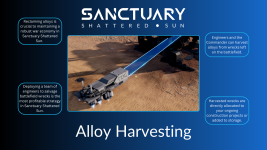
Every unit destroyed—whether yours or the enemy's—leaves behind wrecks that can be harvested for valuable alloys. Sending in a team of engineers to salvage battlefield wrecks is the most profitable move available in Sanctuary Shattered Sun.
Flux economy in Sanctuary Shattered Sun is a system that emulates a continuous and dynamic stream of resource generation and expenditure. Unlike traditional RTS games where players gather resources in bulk and use them as needed, flux economy ensures that resources are constantly produced and consumed, requiring players to adopt a more realistic and strategic approach to resource management. This system involves steady production through various buildings or units, where higher-tier structures enhance production rates, incentivising technological advancement.
Resource consumption in a flow economy is equally continuous, with resources being used for maintaining buildings and producing units. Players must balance their resource production with consumption to avoid deficits that can hinder their economy and strategy. This dynamic allocation necessitates constant monitoring and adjustment to ensure efficient resource use and economic stability. The continuous nature of flux economy fosters real-time decision-making, leading to a more engaging gameplay experience where efficient resource management can significantly impact unit production, technological progress, and defence capability. For example, a player must maintain a positive energy balance by ensuring their energy production exceeds consumption, or risk power shortages that affect their gameplay capabilities.
In the bottom right of the game user interface (UI), you'll find the Economy Panel. Despite its inconspicuous appearance, this panel is arguably the most important feature in Sanctuary Shattered Sun. Let’s examine it in detail:
1. Energy Production and Consumption.
These two values show the amount of energy being produced (+) and the amount being consumed (-). Here you can see we are producing 80 energy and using 23.Energy production occurs by building energy generators, with each tier producing a higher amount of energy. Tier one produces 10 energy, tier two supplies 200 energy, while tier three adds 1000 energy to your economy. Additionally, some units produce their own supply of energy. For example, the EDA Commander has an internal production of 50 energy per second.
Energy is consumed in several different ways, such as building units at the land factory or constructing new buildings. Some buildings also require a constant energy supply. Shield generators and radar installations are prime examples. One tier one energy generator (+10 energy) can support a single tier one radar (-10 energy).
2. Harvest Energy Income.
Harvesting is an essential part of maintaining a robust war economy in Sanctuary Shattered Sun. Engineering units can be ordered to strip the landscape of available biomatter, including trees, bushes, and other organic matter. The two values displayed show the per-second harvesting rate and the total amount harvested throughout the entire game.3. Energy Storage and Balance.
This curved bar provides a quick overview of your energy reserves and the balance between production and consumption. In this example, the large figure in the centre indicates a current surplus of +57. The top figure of 6K shows an energy storage capacity of 6000. The lower figure shows the current amount of stored energy. Since we are running a surplus, we have the full 6000 energy in storage.When you start constructing units and structures, the balance will shift from a surplus (+) to a deficit (-) depending on energy consumption. Storage capacity allows you to continue efficient creation of units and buildings even if the balance is negative. You can increase your energy storage capacity by building additional storage structures. For instance, the guard storage facility adds 10,000 to your energy storage capacity.
It's important to maintain a positive energy balance, as running out of energy will cause your economy to stall. A stalled economy will impact unit production, building construction, and other vital functions, severely impacting your strategic capabilities. Therefore, always monitor your energy reserves and ensure that production consistently meets or exceeds consumption.
4. Alloys Storage and Balance
The bar on the right side of the UI is an 'at a glance' indicator of your current alloy balance and storage. The central figure, here +14, shows whether you are running a surplus or a deficit. The top figure represents the maximum alloys that can be stored, which in this case is 500, while the lower figure indicates the current stockpile. In this example, because we’re running a surplus, the available stockpile is 500. It is important to note here that a lack of storage capacity means that anything being generated is wasted.Building units and constructing structures consume alloys from your production. If production cannot meet demand, you’ll start to use up your storage. The base storage capacity is 500 alloys. Additional storage structures can be built, each adding 1000 to your capacity. If you plan to embark on a costly building project, such as a tier four assault unit, it may be worthwhile to invest in additional storage first to prevent your economy from grinding to a halt during construction.
Just as with energy, running a deficit on alloy production with nothing stored will cause production to stall. This will have a significant impact on your ability to produce units for attack or defence, or to build new structures.
5. Alloy Production and Consumption.
These two values show the amount of alloys being produced and the amount of alloys being consumed. Alloys are produced in several ways. On the map, you will find alloy deposits that can be exploited by building Alloy Extractors over them. Alloy Extractors come in three tiers. Tier one extractors generate 1 alloy per second, tier two extractors yield 4 alloys per second, and tier three extractors output 10 alloys per second. Unlike basic energy generators, the number of alloy extractors you can deploy is finite, creating a natural limitation on alloy extraction. For instance, if there are only ten alloy deposits on the map, the maximum amount of alloys that can be extracted is 100 (with ten tier three extractors producing 10 alloys each). Therefore, it becomes essential to explore alternative methods of alloy production.Perhaps the least efficient method of enhancing alloy production is to build alloy furnaces. These tier three structures produce 10 alloys at the cost of 1000 energy. To power one alloy furnace, you need a single tier three energy generator, which will produce the same amount of alloys as a tier three extractor.
6. Harvest Alloys Income.
Given the finite nature of alloy deposits, these two numbers are the most important indicators of economic strength in the game. The top number represents the amount of alloys currently being harvested per second, while the bottom number shows the total alloys harvested so far. Harvesting can almost be considered 'free' alloys, as it doesn't require an alloy deposit or costly infrastructure investments in a series of tier three energy generators supporting alloy furnaces.Every unit destroyed—whether yours or the enemy's—leaves behind wrecks that can be harvested for valuable alloys. Sending in a team of engineers to salvage battlefield wrecks is the most profitable move available in Sanctuary Shattered Sun.